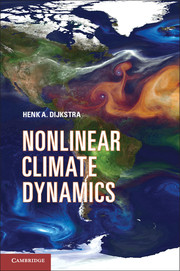
Nonlinear climate dynamics
by
Dijkstra, Henk A.
Title
:
Nonlinear climate dynamics
Author
:
Dijkstra, Henk A.
ISBN
:
9780521879170
Personal Author
:
Dijkstra, Henk A.
Physical Description
:
xii, 357 pages : illustrations (some color) ; 27 cm
Abstract
:
"This book introduces stochastic dynamical systems theory in order to synthesize our current knowledge of climate variability. Nonlinear processes, such as advection, radiation and turbulent mixing, play a central role in climate variability. These processes can give rise to transition phenomena, associated with tipping or bifurcation points, once external conditions are changed. The theory of dynamical systems provides a systematic way to study these transition phenomena. Its stochastic extension also forms the basis of modern (nonlinear) data analysis techniques, predictability studies and data assimilation methods. Early chapters apply the stochastic dynamical systems framework to a hierarchy of climate models to synthesize current knowledge of climate variability. Later chapters analyse phenomena such as the North Atlantic Oscillation, El Niño/Southern Oscillation, Atlantic Multidecadal Variability, Dansgaard-Oeschger Events, Pleistocene Ice Ages, and climate predictability. This book will prove invaluable for graduate students and researchers in climate dynamics, physical oceanography, meteorology and paleoclimatology"-- Provided by publisher.
"Chapter 1: Climate Variability Complex motions on the sphere; CCDGAD, Aerial Boundaries, Michael Hedges. Human life is possible because of the specific conditions of the fluid envelopes surrounding the Earth. These fluid envelopes and the processes affecting their behavior are usually grouped into one system: the climate system. Quantities in the climate system, such as temperature and precipitation, vary on many time scales and these variations are highly relevant for many aspects of human life, such as food production and safety. There are many very good textbooks containing a description of the components of the climate system (Peixoto and Oort, 1992; Ruddiman, 2001), the relevant processes (Hartmann, 1994) and the modeling of the development of this system (McGuffie and Henderson-Sellers, 2006; Neelin, 2011). Many of these books first introduce the radiation balance with all the physical, chemical and biological processes affecting it. Next, the large-scale atmospheric circulation and ocean circulation are considered followed by the smaller-scale processes in these components of the climate system. Finally, the role of the biosphere and cryosphere are discussed. This is a book in which variability in the climate system is viewed from a stochastic dynamical systems framework"-- Provided by publisher.
Subject Term
:
Climatology -- Statistical methods.
Dynamic climatology.
Electronic Access
:
| Library | Material Type | Item Barcode | Shelf Number | Copy |
|---|
| IIEMSA | General Books | 33168025752581 | 551.601175 D575N 2013 | 1 |